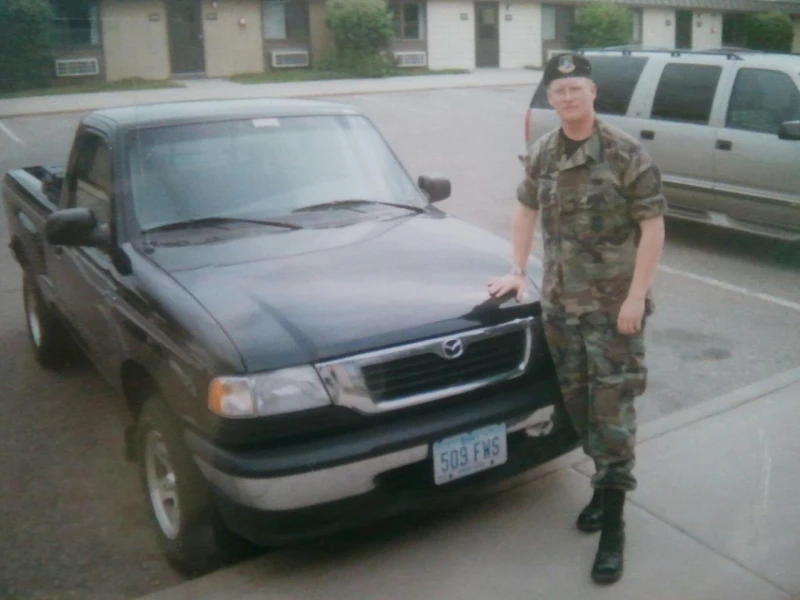
I’m Fine
I Was Fine. I Said So For 20 Years.
A veteran’s honest account of invisible wounds, silent struggles, and fighting a system that should be on our side.
Before I joined the United States Air Force, I was an athlete, partly due to my dad not allowing me to sit around.
I swam competitively from a young age through high school, and enjoyed it immensely. I ran cross country in high school to get in shape for swim team in the winter. I went on summer bike trips covering 50 miles a day — sometimes more (when we got lost!) I was the kind of person whose father was always on the go (and still is) so, I was always on the go.
When I enlisted, I kept that up. I swam laps. I met every military fitness requirement without issue. I was young, strong, and had no reason to believe any of that was about to change.
Then I came back from Saudi Arabia.
The Deployment That Changed Everything
In November 1999 I was deployed to Prince Sultan Air Base in Saudi Arabia as a Security Forces member. I returned in February 2000. Three and a half months. That is all it took.
After I came home I stopped swimming. I felt tired. Not the kind of tired that goes away after a good night’s sleep — a different kind. A heavy, persistent, unreasonable exhaustion that did not make sense for someone my age.
But I explained it away. I told myself I just needed to adjust. I told myself everyone feels this way sometimes. I did not have words for what was happening to me. I had never heard of Chronic Fatigue Syndrome. Nobody told me it existed. So I did what I was trained to do.
I pushed through. I stepped up. I did the job.
Twenty Years of “I’m Fine”
A few years after my service ended, things started getting worse. The fatigue was still there but now there was something else — a fog that settled over my thinking. I started having a hard time being around groups of people. I did not feel like myself, but I could not explain what feeling like myself even meant anymore.
I drank alcohol to relax my brain. To quiet whatever was happening up there that I did not have a name for.
I went to my doctor appointments. I sat across from my doctor. And when they asked how I was doing I said the same thing every time.
“I’m fine.”
And then I went about my day.
I did that for twenty years. There were a few medical issues along the way, but the general consensus I put out was that everything was fine.
Twenty years of appointments. Twenty years of “I’m fine.” Twenty years of a body and a mind that were telling me something was wrong, and a voice inside that said we do not complain. Others had it worse. Drive on.
That voice is not strength. I know that now. But I did not know it then.
When the Body Stops Waiting
Eventually the body stops waiting for you to pay attention.
My wife noticed things I was ignoring. She encouraged me to go back to the doctor. I brushed it off for another year — because that is what we do, those of us who were trained to push through. Finally I went.
I was diagnosed with Ulcerative Colitis, high blood pressure, and GERD. Conditions that had been building quietly while I was busy saying “I’m fine.”
A few years later the migraines got worse. Not normal headaches — migraines so debilitating I had to close my eyes. I had to lie on the couch in darkness while my head pounded. Migraines so severe I would lose my vision. This could be anywhere from an hour to four hours. Afterward I would be wiped out sometimes for multiple days.
I finally told my doctor about them. They ordered a head scan to rule out anything structural. The scan came back clear — nothing wrong with my brain, nothing wrong with how it was functioning. On paper I was fine.
But I was not fine. The migraines kept coming. The exhaustion kept coming. And “nothing structurally wrong” is not the same as nothing wrong. It just means the damage is the kind that does not show up on a scan.
Still I minimized. Still I carried the weight of the military’s unspoken rule — that needing help is a kind of failure or weakness.
The Conversation That Changed Everything
Finally I talked to a friend I had served with. He told me about Chronic Fatigue Syndrome.
And things just lined up.
The exhaustion that started in Saudi Arabia. When I stopped swimming. The brain fog. Not feeling like myself. Struggling around people. The years of non-restorative sleep. The crashes after any physical activity. The feeling of being disconnected from my own body. All of it — every piece I had been carrying separately for over two decades — suddenly had a name.
I got rated for PTSD. For tinnitus. Both service-connected.
But I am still fighting for CFS.
The Fight That Should Not Have to Happen
That was not the end of the story. It was the beginning of a different kind of battle.
I have been fighting for my CFS rating ever since (2024). I have been denied. I have appealed. I have had a VA examiner ask me one question during my examination before concluding I did not have CFS. I have had a licensed physician’s formal diagnosis labeled as “non-medical evidence.” I have appealed four times. I hired an attorney. I am still fighting.
All of this while managing the very conditions that make fighting so hard. Brain fog. Exhaustion. Migraines. PTSD. The daily weight of a body that does not recover the way other people’s bodies do.
And here I am — fighting for my CFS rating when all the evidence is clear as day.
What I Want Other Veterans to Know
I was in for four years. Not thirty. Not forty. Four years.
I did not serve in an active war. I never had to shoot anyone. I was never shot at. I never lost a limb.
For a long time I told myself that meant I must be alright. I was “whole”, no way could I have PTSD or some other illness from when I served. I looked at veterans who served longer, and had physically sacrificed limbs and felt embarrassed by my own struggles. I looked at guys I served with who seemed fine and questioned whether my own experience was real.
That thinking almost cost me everything. It cost me twenty years of my health.
Here is what I know now:
A deployment does not need to last years to break something in you. Three months in the wrong place breathing the wrong air was enough to change the entire trajectory of my life. The VA does not rate service length. It rates damage. And the damage is real.
The “man up” culture that the military instills in us — the push through, drive on, embrace the suck mentality — it keeps us alive in the field. It kills us at home. It keeps us sitting in doctor’s offices saying “I’m fine” for twenty years while our bodies quietly fall apart.
You are not weak for being sick. You are not exaggerating. You are not less of a veteran because someone else who went through the same things came out the other side differently. Biology is not a moral judgment. Your body was damaged in service to this country and you are entitled to care — regardless of how long you served, regardless of whether your wounds are visible, regardless of whether the guy who stood next to you in Saudi Arabia seems fine.
File the claim. Tell your doctor the truth. Stop saying “I’m fine” when you are not.
I said it for twenty years. It did not make me stronger. It just made me sicker.
If you or another veteran are experiencing a crisis or need help, you can reach out to the Veterans Crisis Line for support.
Nathan Ellingson served in the United States Air Force from 1997 to 2001 as a Security Forces member. He was deployed to Prince Sultan Air Base in Saudi Arabia from November 1999 to February 2000. He is currently service-connected for PTSD and tinnitus and is actively pursuing additional claims for conditions connected to his military service.
A note on how this post was written:
One of the realities of living with Chronic Fatigue Syndrome and brain fog is that organizing your thoughts into coherent words is genuinely hard — even when you have something important to say. I used Claude AI to help me take my own words and experiences and shape them into a format that others could read. Every story, every experience, and every detail in this post is mine. Claude helped me find the structure to tell it.
I want to be transparent about that because honesty is kind of the whole point of this post — and because if using a tool like AI helps a veteran with brain fog tell a story that might reach someone else who needs to hear it, then that tool is worth mentioning.