
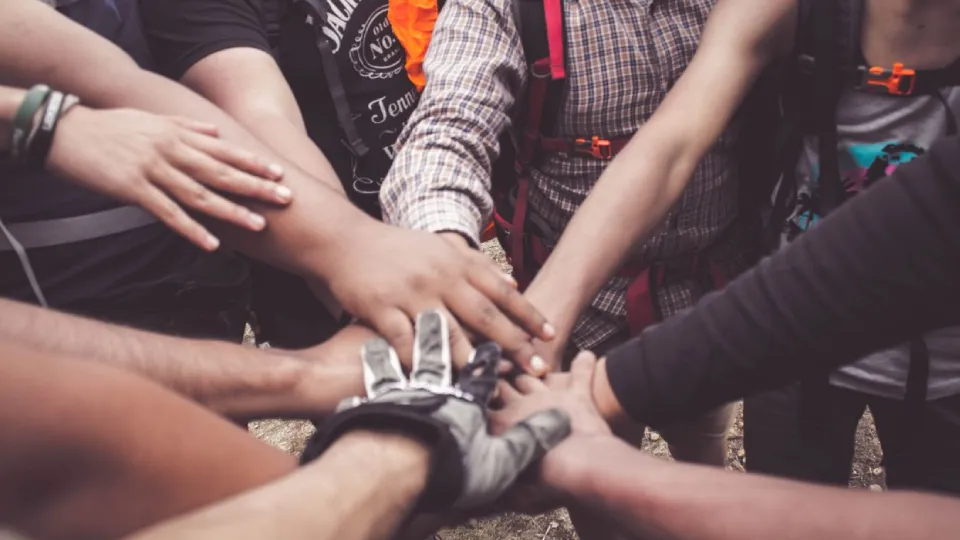
Not Partisan
Somewhere along the way, everything became political.
Not just elections or taxes. Science. Healthcare. Education. The free press. Immigration. Even something as simple as helping a neighbor can be interpreted as a statement about which political team you belong to.
That’s a strange place for a country to end up.
In my first post, The Oath, I wrote about how nearly every issue today seems to place us into one political camp or another. But the more I’ve thought about it, the more I’ve realized that most of these issues aren’t inherently political at all. They become political because we’ve confused two very different questions.
The first is how we solve problems. The second is whether people deserve dignity in the first place.
We should debate the first. We should never have to debate the second.
Reasonable people can disagree about budgets, taxes, the size of government, or whether a program should be managed by states or by the federal government. Those are legitimate philosophical differences. Good people can look at the same problem and honestly arrive at different solutions. That is the great thing about being part of this country.
But somewhere along the way, the conversation stopped being about how.
It became about whether.
Whether people deserve healthcare when they’re sick.
Whether education should be available to everyone.
Whether families who fall on hard times deserve a helping hand.
Whether every person possesses inherent dignity simply because they’re human.
Those aren’t policy questions. They’re moral ones.
I think about the people I served with. If one of them came home, lost their job, couldn’t make rent, or needed medical care they couldn’t afford, none of us would sit around debating whether they deserved help. We’d ask what they needed before we asked how they got there. We’d find a way to help because that’s what you do for someone you’ve stood beside.
That’s the thing—I don’t believe a person’s dignity should depend on whether I know their name.
So why does that instinct change the moment we’re talking about people we don’t know?
The math doesn’t change.
The person doesn’t change.
Only the label does.
And labels are powerful. They’re also dangerous. It’s easy to care about a person standing in front of you. It’s much easier to become suspicious of a category. Once someone becomes “the poor,” “an immigrant,” “a conservative,” “a liberal,” or any other label, they stop being an individual and become an idea we can argue about. Politics thrives on categories because categories are easier to debate than human beings.
It wasn’t always this way.
For much of our history, Americans argued passionately over how programs should be designed, how they should be funded, and what role government should play. Social Security, Medicare, Medicaid, veterans’ benefits, disaster relief, and public education all sparked fierce debate. But much of that debate centered on implementation, not whether a society has some responsibility to care for its people.
Somewhere along the way, we’ve blurred that distinction.
Today, it often feels like compassion itself has become partisan. Wanting your neighbor to have healthcare, believing every child deserves an education, or thinking people should be treated with dignity can earn you a political label before you’ve even offered an opinion about how any of those things should work.
That seems backward to me.
I took an oath to defend the Constitution. Not a president. Not a political party. Every man and woman who has worn this country’s uniform took the same oath.
Over time I’ve come to believe that oath points inward as much as it points outward.
The Constitution isn’t just a document. It’s a promise about the kind of nation we’re trying to be. Defending that promise means defending the dignity of the people it was written to serve. You can’t claim to love the idea of America while deciding that some Americans matter less than others.
Disagree with me on the how. Debate taxes, budgets, regulations, federal authority, or state authority. I’ll gladly have those conversations because that’s exactly what democracy is supposed to look like.
But don’t tell me that believing people deserve dignity, healthcare, education, and the opportunity to build a better life is somehow a partisan position.
Those aren’t Democratic ideas.
They aren’t Republican ideas.
They’re human ideas.
The moment we confuse how with whether, we stop solving problems and start questioning one another’s humanity.
I think that’s the line we’ve lost.
And I think it’s one worth finding again.
Where do you draw the line between the how and the whether? I’d genuinely like to hear your thoughts.
“How” is easy (er). Who gets what? That’s the argument of power and wealth.
You’re right that “how” is never neutral—the mechanisms we choose absolutely determine who benefits and who bears the cost. But I think that’s exactly why we need to keep the distinction. The moment “how” and “whether” collapse into one question, we can’t disagree on the best mechanism without being accused of lacking compassion. You might believe the most effective path runs through economic growth or community programs rather than federal ones—that’s a real disagreement worth having, not a sign you don’t care. I think you’re right that questions of power and wealth are at the heart of the “how.” But I think we’re more likely to solve it honestly if we first agree that solving it matters—that some baseline of dignity isn’t negotiable—then fight like hell about the best mechanisms. Otherwise, debates over policy quickly become debates about people’s motives or about whether some people deserve help at all. Once that happens, I believe it’s much harder to solve the problem.